

Table of Contents
ToggleHow to Start Investing: Learn Stocks, ETFs & Mutual Funds
Have you ever felt like the world of finance is a members-only club, speaking a language you don’t understand? From news anchors shouting about the Sensex to friends casually mentioning their ETF investments, it’s easy to feel left behind. Financial Markets This guide is your all-access pass. We’re going to pull back the curtain on the financial world and explain everything—from the very basics of what a stock is to the complex dynamics of market cycles.
Our mission is simple: to transform you from a complete beginner into an informed, confident individual who can understand financial news and, perhaps, even take the first steps on their own investing journey. So, grab a cup of coffee and get ready to demystify the market, one concept at a time.
Section 1: The Absolute Foundations of Investing
Before you can build a house, you need to understand what a brick is. In finance, that brick is a stock.
What Are Stocks & Shares?
In the simplest terms, a stock (or share) represents a tiny piece of ownership in a company. When a company, let’s say a popular tech giant, needs to raise money to expand or develop new products, it can sell ownership stakes to the public. Each of these ownership stakes is a share of stock.
When you buy a share, you become a part-owner of that company. If the company does well and becomes more profitable, its value often increases, and so does the value of your stock. This is the primary way people make money in the stock market. You buy low and sell high.
To put this into perspective, consider the total number of shares a company has. If a company has 10 million shares, and you own 10,000 of them, you own 0.1% of that company. While you won’t be making business decisions, your investment success is tied directly to the company’s performance.
What Are Dividends?
A dividend is a portion of a company’s profit that is paid out to its shareholders. It’s a “thank you” check for being a part-owner. Not all companies pay dividends, but many large, well-established companies do, often on a quarterly basis.
Think of it this way: a company earns a profit. Instead of reinvesting all of it back into the business, it decides to share a piece of the pie with its owners (the shareholders). Dividends can be a great way to generate passive income from your investments. Some investors focus their entire strategy on building a portfolio of dividend-paying stocks to create a consistent cash flow.

Section 2: Investing in a Group (Beyond Individual Stocks)
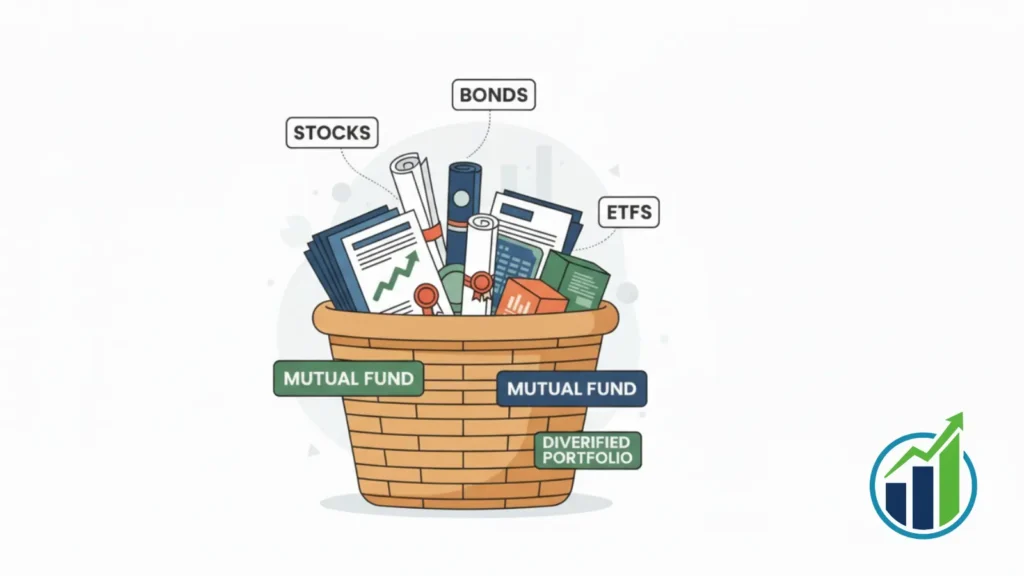
Buying and researching a single stock can be risky. What if that one company fails? This is where diversification comes in. The most effective way to diversify is to invest in a “basket” of stocks, which is what indexes, mutual funds, and ETFs are all about. Financial Markets For Beginners
What Is an Index? The Market’s Thermometer
An index is not something you can buy or sell directly. It is a benchmark, a tool that measures the overall performance of a specific group of stocks. It serves as a “market thermometer.”
- The Nifty 50 is a famous index that tracks the performance of the 50 largest and most actively traded companies on India’s National Stock Exchange.
- The S&P 500 tracks the 500 largest U.S. companies.
When you hear that the Sensex is up, it generally means that the top companies in India’s market have performed well on that particular day. It gives you a quick snapshot of market health without having to check every single stock.
What Are Mutual Funds? The Professionally Managed Basket
A mutual fund is a professionally managed investment fund that pools money from many investors to purchase a diversified portfolio of securities.
- How it Works: You give your money to a fund manager, who then uses that money to buy a wide variety of stocks, bonds, or other assets on your behalf.
- Key Benefits: You get instant diversification and professional management. It’s ideal for beginners who don’t have the time or expertise to research individual stocks.
What Are ETFs (Exchange-Traded Funds)? The Basket That Trades Like a Stock
An ETF is very similar to a mutual fund. It’s a basket of different investments, but with one key difference: an ETF trades on a stock exchange just like a regular stock.
- Key Advantage: You can buy or sell ETF shares throughout the day at their current market price, whereas mutual funds are priced only once a day after the market closes.
The Link to Indexes: Many ETFs are designed to track a specific index. For example, by buying a Nifty 50 ETF, you are essentially investing in all 50 of those companies in the exact proportion they hold in the index. This is an extremely popular and effective way for beginners to get started with investing.
Section 3: Understanding the Market's Moods
Investing isn’t a straight line. The market is constantly in a state of flux, and understanding some key terms can help you stay calm and make rational decisions, especially during periods of volatility.
Bull vs. Bear: The Market’s Mood
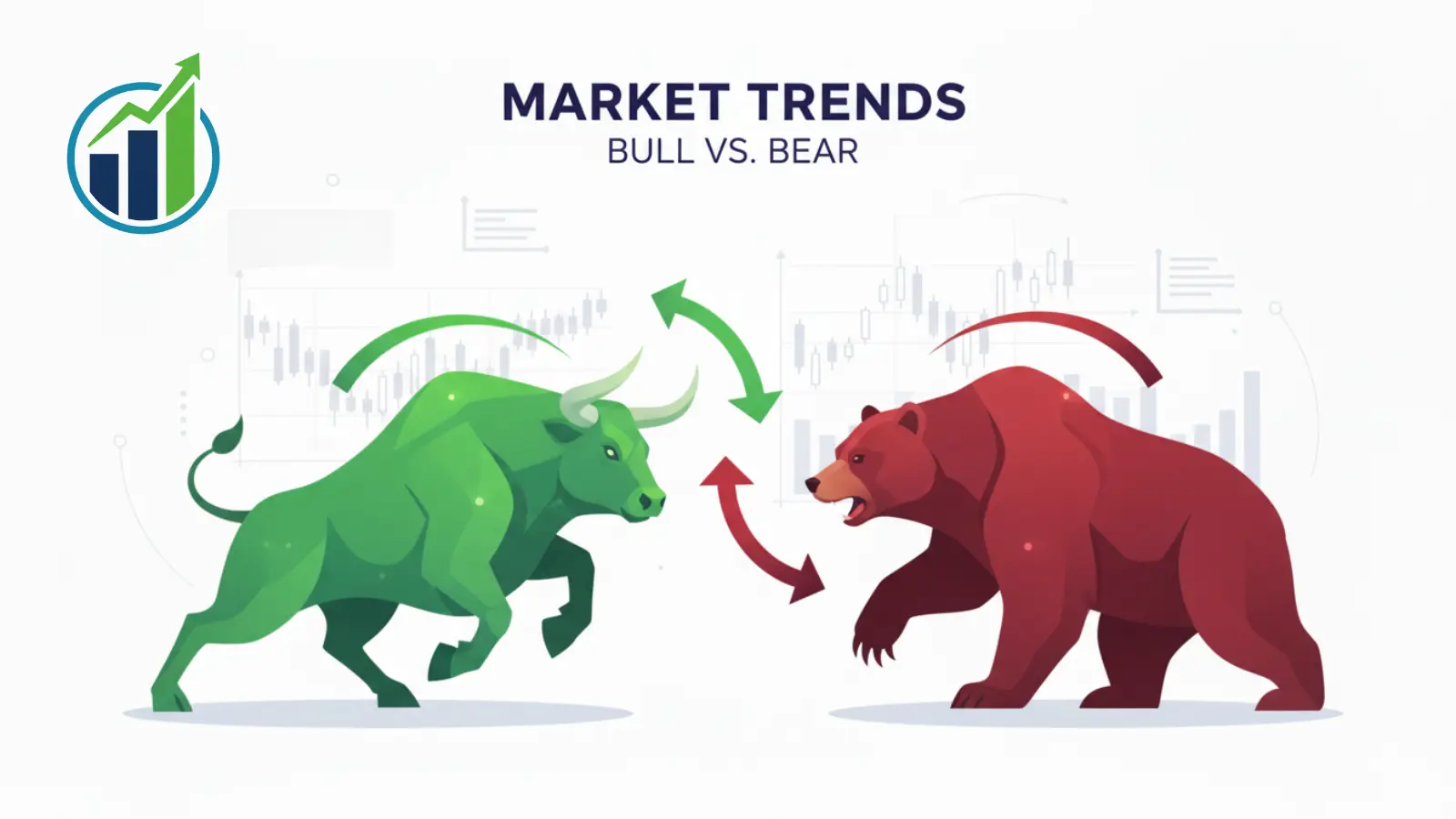
The terms “bull” and “bear” are used to describe the overall mood of the market. They are named after the way each animal attacks: a bull thrusts its horns up, while a bear swipes its paws down.
- Bull Market: This is a period when stock prices are generally rising, and there is a sense of optimism among investors. It is typically defined as a rise of 20% or more from a recent low.
- Bear Market: This is a period when stock prices are falling, and there is a sense of negativity and fear. A bear market is officially declared when a major index falls by 20% or more from its recent high.
It’s important to remember that markets constantly cycle between these two phases. The historical record shows that bull markets last longer and are more powerful than bear markets, but both are a normal part of the process.
Market Correction vs. Market Crash
While both are market downturns, they are very different in their severity and speed.
- Market Correction: A correction is a temporary dip in the market, typically defined as a decline of at least 10% from its recent peak. Corrections are a normal and healthy part of the market cycle that help to stabilize prices after a period of rapid growth.
- Market Crash: A market crash is a sudden, dramatic, and often unexpected decline in prices. A crash is much more severe and rapid than a correction, with prices fall in a very short period of time. A crash is often triggered by major economic or political events, such as the 2008 financial crisis.
What Is a Market Bubble?
A market bubble occurs when the price of an asset or sector rises far beyond its real, underlying value. This is typically driven by investor excitement and speculation rather than the company’s actual performance.
Bubbles are easy to see in hindsight but almost impossible to spot when they’re happening. The most famous example is the Dot-Com Bubble of the late 1990s, when a wave of excitement about the internet led to many tech companies being ridiculously overvalued, only for their stock prices to crash spectacularly in the early 2000s when the bubble burst.
Section 4: The High-Risk Zone (A Word of Caution)
What is F&O (Futures and Options)?
Futures and Options (F&O) are a highly complex and risky form of trading known as derivatives. They are not about owning a piece of a company. Instead, they are contracts to buy or sell an asset at a predetermined price on a future date.
- The Difference: While traditional investing involves buying a stock to own a piece of a company for the long term, F&O is used by experienced traders to speculate on short-term price movements.
- The Crucial Warning: The potential for significant profit is matched by an equally high potential for significant loss. For a beginner, it is crucial to stay away from F&O. Building a strong foundation with long-term, low-cost investing in stocks and ETFs should be your absolute priority.
Common Investing Mistakes to Avoid:
Now that you have the knowledge, here are a few common pitfalls to steer clear of:
- Chasing Hot Stocks: Don’t buy a stock just because a friend or a news report says it’s “hot.” Do your own research or, better yet, stick to a diversified ETF.
- Timing the Market: Don’t try to predict when the market will go up or down. As the legendary investor Peter Lynch once said, “Far more money has been lost by investors preparing for corrections or anticipating corrections than has been lost in corrections themselves.”
- Panic Selling: When a bear market or correction hits, resist the urge to sell everything. Market downturns are a normal part of the cycle, and historically, markets have always recovered and gone on to reach new highs.
- Putting All Your Eggs in One Basket: Diversification is your best friend. A diversified portfolio in a mutual fund or ETF is far less risky than putting all your money into a single company.
Conclusion: Start Simple, Start Now
The most challenging part of investing is simply getting started. The good news is, you don’t need a lot of money to begin. With the rise of technology and low-cost platforms, you can start with a small amount and a simple plan.
The key is to focus on your long-term goals and not let short-term market movements scare you into making emotional decisions. By understanding these core concepts, you’ve already taken a massive step toward becoming a more confident and successful investor.
Disclaimer: This blog post is for educational purposes only and should not be considered professional financial advice. Always consult with a certified financial advisor before making any investment decisions.
Frequently Asked Questions (FAQs)
Q1: What's the difference between investing and trading?
A: This is a key distinction. Investing is a long-term strategy, often spanning years or even decades, with the goal of building wealth steadily over time. Investors typically focus on a company’s fundamentals, like its profitability and long-term growth prospects. Trading, on the other hand, is a short-term strategy, where you try to profit from daily or even hourly price fluctuations. Traders use technical analysis and short-term trends to buy and sell frequently. The blog post primarily focuses on long-term investing, which is much more suitable for beginners.
Q2: How do I actually start investing?
A: You can start by opening a brokerage account with a registered financial institution. You’ll need to provide some personal information for verification. Once your account is funded, you can begin buying stocks, ETFs, or mutual funds. Many platforms allow you to start with very small amounts of money
Q3: Is my money safe in a brokerage account?
A: Yes, for the most part. In India, for example, your securities are held with a depository (like NSDL or CDSL), not the brokerage itself. The brokerage is just a platform to facilitate transactions. While the value of your investments can go up or down, the safety of the securities themselves is protected.
Q4: How do I choose between a mutual fund and an ETF?
A: For most beginners, either is an excellent choice. Mutual funds are often actively managed by an expert, while ETFs are typically designed to track an index automatically. ETFs generally have lower fees than mutual funds and offer more flexibility since you can buy and sell them throughout the day. Mutual funds are a good option if you prefer a hands-off approach and are comfortable with a fund manager making all the decisions for you.
Q5: How much money do I need to start investing?
A: You can start with a very small amount, sometimes as little as ₹100 through a Systematic Investment Plan (SIP) in a mutual fund. For ETFs and stocks, many platforms allow you to buy even a single share. The key is to start with what you can afford, no matter how small, and invest consistently. The power of compounding is more effective with time than with a large initial amount.
Q6: Should I invest in F&O?
A: The short answer is no, not if you are a beginner. F&O trading is extremely high-risk and complex. It requires significant knowledge of market analysis, risk management, and the ability to tolerate huge potential losses. For a beginner, the focus should be on building a solid foundation with long-term, low-cost investments like ETFs and mutual funds.