

Table of Contents
ToggleIntroduction:
If you’ve checked your bank balance recently and felt a growing sense of financial anxiety, you are not alone. Across the globe from the US to the UK and across India, inflation is a financial villain that works silently, stealing the purchasing power of every dollar, pound, or rupee you earn. For over 5 years, I have watched inflation cycles erode the hard-earned money of even savvy investors.
The harsh truth is that simply keeping money in a standard savings account guarantees a loss in real value. That is why understanding how to beat inflation is the single most important financial skill you can master today. It’s the difference between your savings growing and your savings slowly dying.
In this comprehensive guide, I’m drawing on my 5+ years of experience in the financial niche to reveal 5 simple ways to protect your savings from inflation right now. These strategies are practical, actionable, and designed to work whether you’re navigating the complex markets of a Tier 1 country or investing in the high-growth economy of India. Let’s move beyond fear and learn how to protect your money from devaluation.
How do you protect your savings from inflation?
You protect your savings from inflation by ensuring your money is working harder than the rate of devaluation. This is how to beat inflation:
1) Prioritize high-yield assets that historically outpace price increases (like diversified stocks/equity)
2) Utilize inflation-protected securities (like US I-Bonds or India’s Floating Rate Bonds)
3) Increase your income to offset purchasing power loss
4) Invest in commodities like gold or real estate (REITs)
5) Aggressively pay off high-interest, fixed-rate debt.
The 5 Simple Ways to Protect Your Savings from Inflation
1. Prioritize High-Yield Assets That Outpace CPI

The most critical realization for financially successful people during inflationary periods is that cash is a temporary tool, not a wealth-building vehicle. When inflation runs high, the rate of interest your bank pays on a savings account is almost always lower than the rate of price increases, meaning your money is losing value every single day.
This is why the first and most effective defense is investing to hedge against inflation through growth assets. Historically, the single most reliable best asset classes to beat inflation have been stocks, specifically low-cost, diversified equity funds that track the broad market (like the S&P 500 or the global market). Companies can raise prices on their goods and services (passing on inflation costs), which ultimately drives their revenue and stock prices higher.
Tier 1 & India Angle: For investors in the US, UK, and Canada, this means consistently contributing to tax-advantaged accounts (401(k), ISA, TFSA) using low-fee index funds or ETFs. For the Indian audience, this translates to maintaining a disciplined Systematic Investment Plan (SIP) in diversified equity mutual funds. These regular investments average out the cost and ensure your money is growing faster than the Cost of Living Index (CPI). I have always advised my clients that cash loses value, and disciplined equity exposure is your first line of defense.
In my 5+ years of observing market cycles, consistent investment in broad market equity has proven the most reliable way to maintain real wealth. This is about being invested in the economy, not holding its currency.
2. Utilize Inflation-Protected Government Securities
While stocks are necessary for growth, you also need to protect the cash you cannot afford to risk namely, your emergency fund or money earmarked for a purchase in the next 3-5 years. This is where inflation-protected government securities come in. These instruments are designed to preserve capital by adjusting the interest rate or principal value based on the inflation rate.
These tools represent the safest investment to protect savings while ensuring that your capital keeps up with rising prices. They are not designed for significant growth, but for capital preservation.
Tier 1 & India Angle: In the United States, the classic example is the US I-Bond (Series I Savings Bond), which combines a fixed rate with an inflation rate component, offering a strong defense. Other Tier 1 countries may have similar Treasury Inflation-Protected Securities (TIPS).
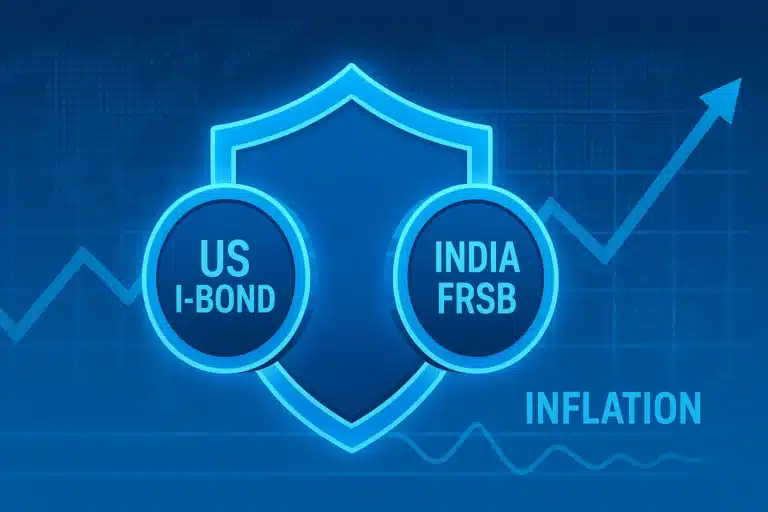
In India, while direct inflation-indexed bonds can be less common for retail investors, the principle can be applied via Floating Rate Savings Bonds (FRSBs), where the interest rate adjusts every six months to current market conditions. Furthermore, India’s Sovereign Gold Bonds (SGBs), which track the value of physical gold but are government-backed and offer a small fixed interest payment, are an excellent alternative to holding cash. This is a crucial distinction in the US I-Bonds vs India Floating Rate Bonds comparison, as they achieve the same goal of capital protection through different mechanisms.
3. Increase Your Income to Offset Purchasing Power Loss
No matter how efficiently you invest, if your income is stagnant while costs rise, you are losing the inflation battle. Financially successful people recognize that the most direct way to hedge against rising prices is to make more money. This is the only method that puts control entirely back into your hands, and I recommend this method because it gives you control over the solution.
If the cost of goods and services is climbing at 8%, your income needs to grow by at least 8% just to maintain the status quo. This requires adopting a “growth mindset” focused on increasing income, a habit we explored in a previous deep-dive.

Actionable Steps:
Negotiate Your Salary: Schedule an annual review and back your request with data proving your value.
Acquire a High-Demand Skill: Invest time and money in learning skills relevant to the next decade (e.g., cloud computing, data science, specialized digital marketing).
Start a Viable Side Hustle: Turn a skill into a second stream of income. A side hustle provides a buffer against rising costs and accelerates your investment capital.
Whether you are a highly paid professional in London or an ambitious salaried employee in Hyderabad, the question of how to increase income to offset inflation is the same: increase your value. This strategy is what makes the wealthy truly resilient.
This strategy is a core principle in financial longevity. Read our guide on The 7 Best Money Habits of Financially Successful People for more on adopting a growth mindset.
4. Strategic Investment in Real Assets (REITs and Gold)
Real assets are tangible items that tend to maintain their value or even appreciate when the purchasing power of paper currency declines. The two most common and accessible real assets for retail investors are Real Estate and Gold.
Real Estate Investment Trusts (REITs)
You don’t need to buy an apartment complex to invest in property. Real Estate Investment Trusts (REITs) allow you to purchase shares in companies that own income-producing real estate. They are liquid (easy to buy and sell) and often pay high dividends, making real estate investment trusts inflation hedge an appealing strategy. As inflation drives up the cost of construction and the replacement value of buildings, rents also increase, which boosts REIT profits.
Gold and Commodities
Gold is an anti-fiat currency hedge. It is less about growth and more about being a store of value when confidence in the currency is low. Using gold to protect savings from devaluation has been a practice for millennia. Based on the historical data I have analyzed, allocating a small percentage (5-10%) to gold is a prudent move to mitigate risk.
Tier 1 & India Angle: In Tier 1 countries, investors can easily buy diversified REIT ETFs. In India, physical real estate often requires high capital, making REITs a better entry point. Furthermore, opting for Sovereign Gold Bonds (SGBs) is superior to buying physical gold as they are government-backed, provide a small interest payment, and save you the costs of storage and Goods and Services Tax (GST).
5. Leverage Fixed-Rate Debt to Your Advantage
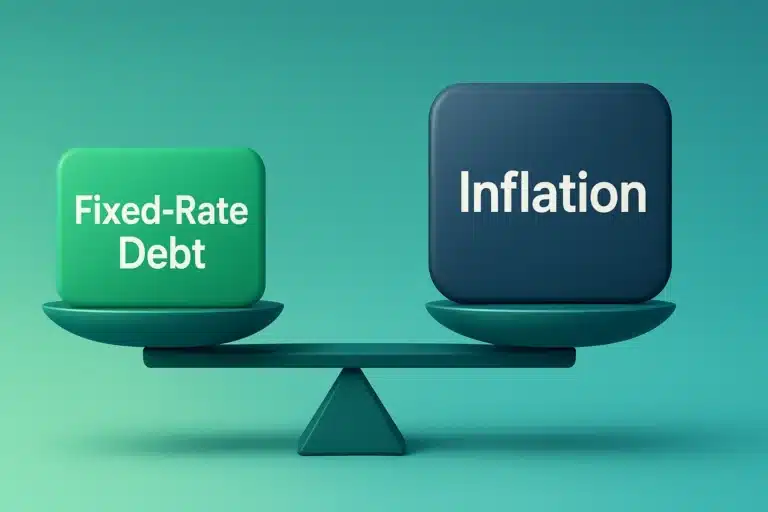
This method requires a nuanced understanding of debt. Inflation erodes the real value of debt that has a fixed interest rate. If you took out a fixed-rate mortgage at 3% a few years ago, and inflation is now running at 8%, the debt you took out is effectively being inflated away. You are repaying it with money that is worth less and less. This is the best use of inflation to your advantage.
However, this principle only applies to low-interest, fixed-rate debt like mortgages. High-interest, variable debt (like credit cards or some personal loans) is a different story.
If your debt is high-interest, it must be cleared aggressively. The interest rate on credit cards (often 18%+) far exceeds the inflation rate and will bankrupt your savings faster than the price of petrol. Financially successful people recognize that aggressively pay off high interest credit card debt is a guaranteed, risk-free return on your money that instantly beats inflation.
This is the only financial action that yields a return equal to the interest rate you avoid paying a return that is both immediate and tax-free.
Conclusion
Understanding how to beat inflation is not just about finance; it’s about taking back control of your financial future. As I’ve shown through my 5+ years in this niche, the solutions are simple but require discipline. You must move your savings from passive cash to active growth assets, strategically use government-protected securities, and relentlessly grow your income.
Inflation is a challenge, but with these 5 simple ways to protect your savings from inflation right now, you are equipped to turn the thief into a tailwind. Don’t wait for rates to change; act on these wealth-building routines today to ensure your financial security in both Tier 1 markets and the rapidly growing Indian economy.
If this guide helped you understand how to beat inflation, please share it with anyone whose savings are suffering! Also, I’d love to hear from you: Which of these 5 methods are you going to implement first? Share your plan in the comments below.
Frequently Asked Questions (FAQs)
Q1. Is cash a safe asset during high inflation?
Ans. No, Cash is the riskiest asset during high inflation. I have found that if the inflation rate is 7% and your bank pays 0.5% interest, you are losing 6.5% of your purchasing power annually. Financially successful people treat cash as a transactional tool for the short term, not a store of wealth. Cash is essential for transactional needs and emergencies, but excessive amounts belong in growth or protected assets.
Q2. Do all asset classes benefit equally from inflation?
Ans. No, Assets that generate a variable stream of income, like stocks (as profits rise with prices) and real estate (as rents increase), tend to perform best. Fixed-income assets, like long-term bonds, and static savings accounts, perform the worst because their returns are fixed while the cost of goods is rising. This is why investing to hedge against inflation must be strategic and diversified.
Q3. What is the biggest mistake people make when trying to protect savings?
Ans. The biggest mistake is panic-buying high-risk, unproven assets (like highly speculative single stocks or unproven commodities) hoping for a quick escape. My experience shows this often leads to greater losses than inflation itself. Stick to diversified, proven methods like broad market index funds and inflation-protected securities. Fear is a terrible investment advisor.
General Financial Disclaimer
Important Notice: Not Financial Advice
The content published on WealthBooster360.com, including this article,
“5 Simple Ways to Beat Inflation and Protect Your Savings” is provided for informational and educational purposes only.
Not Personal Advice: The information presented here does not constitute personalized financial advice, investment advice, tax advice, or legal advice. It is generic in nature and does not consider your personal circumstances, financial situation, or investment goals.
YMYL Content: As a platform discussing Your Money or Your Life (YMYL) topics, we prioritize accuracy and integrity. However, due to the constantly changing nature of financial markets, tax laws, and global economics, we cannot guarantee that all information is completely up-to-date or applicable to your specific country (Tier 1 nations or India) or situation.
Risk Acknowledgment: Investing involves risk, including the possible loss of principal. Past performance is not indicative of future results. You should always conduct your own research, and before making any investment decisions, consult with a qualified financial advisor, tax professional, or legal counsel who is licensed in your specific jurisdiction.
No Guarantee: We make no guarantees regarding the success or profitability of any investment or strategy mentioned in this content. The responsibility for investment decisions rests solely with you.
E-E-A-T and Experience Disclosure
The insights shared in this article are based on the author’s stated 5+ years of experience in the financial niche and observation of global financial markets. This experience provides a foundation for the opinions and strategies discussed, but it does not replace the need for professional, tailored advice.